Shen Zhou
Introduction
Shen Zhou (1427-1509) stands as a towering figure in Chinese art history, celebrated as one of the Four Masters of the Ming Dynasty. His contributions to the Wu School of painting, alongside Tang Yin, Wen Zhengming, and Qiu Ying, helped define a new era of Chinese artistry. Born in Suzhou, a city renowned for its artistic culture, Shen Zhou was deeply embedded in the literati culture of his time. As a painter, calligrapher, and poet, he exemplified the ideal of the scholar-artist, blending literary sophistication with artistic innovation. His works often depict serene landscapes and reflect his philosophical musings, demonstrating a profound connection between humanity and nature. Shen Zhou's legacy continues to influence Chinese art, and his works remain celebrated for their aesthetic beauty and spiritual depth.
Early Life
Shen Zhou was born in 1427 in Suzhou, a city in Jiangsu province known for its cultural and artistic heritage. Growing up in this environment, Shen Zhou was exposed to the rich traditions of Chinese art and culture from an early age. His family was well-off, which afforded him the opportunity to pursue artistic and scholarly endeavors. He received a classical education, which was typical for someone from his social standing, and he was trained in the arts of painting, poetry, and calligraphy. These disciplines were considered essential for a literati artist, and Shen Zhou excelled in all three.
During his formative years, Shen Zhou developed a deep appreciation for the works of past masters, especially those of the Southern Song Dynasty (1127-1279). This admiration would later inform his own style, as he sought to blend traditional techniques with new ideas. His early life in Suzhou, surrounded by the picturesque landscapes of Jiangnan, also deeply influenced his artistic vision. The natural beauty of the region is a recurring theme in his work, celebrated for its lyrical quality and emotional resonance.
Artistic Career
Influences and Style
Shen Zhou's artistic career was significantly shaped by the influence of earlier masters, particularly those from the Song Dynasty (960-1279). He admired the works of artists such as Su Shi and Mi Fu, who emphasized the integration of painting, poetry, and calligraphy. Shen Zhou adopted the literati ideal, which valued personal expression and scholarly reflection over technical precision. This approach is evident in his landscapes, where he often incorporated poetic inscriptions that enhance the emotional and philosophical depth of his paintings.
His style is characterized by a free and expressive use of ink and brush, capturing the essence of the subject rather than its exact appearance. He favored the use of soft, flowing lines and subtle washes of ink to create atmospheric effects, conveying a sense of tranquility and introspection. Shen Zhou's landscapes often depict serene and harmonious scenes, reflecting his contemplative nature and his belief in the unity of humanity and the natural world.
Major Works
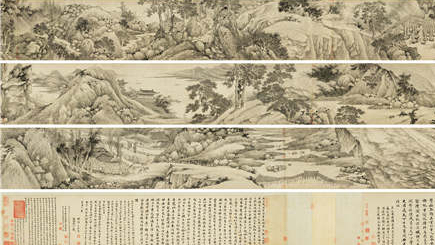
Among Shen Zhou's most celebrated works is the hand scroll titled A Present to Wu Kuan, which exemplifies his mastery of landscape painting. Created over three years, this piece was a gift to his close friend Wu Kuan, a statesman, poet, and calligrapher. The painting depicts a continuously unfolding view of changing landscapes, capturing the beauty and dynamism of nature. It demonstrates Shen Zhou's ability to convey depth and perspective through the use of ink, as well as his skill in integrating poetic elements into his visual compositions.
Techniques and Themes
Shen Zhou was known for his innovative techniques and the thematic richness of his works. His paintings often feature a harmonious blend of traditional brushwork with new stylistic elements. He employed a range of brush techniques, from soft, sweeping strokes to more intricate and detailed lines, to capture the varied textures of nature. His use of ink washes added depth and atmosphere, creating a sense of light and shadow that enhanced the emotional impact of his works.
Thematically, Shen Zhou's art often explores the relationship between humanity and nature. His landscapes convey a sense of unity and balance, reflecting his belief in the interconnectedness of all things. He was also deeply influenced by the philosophical teachings of Confucianism, Taoism, and Buddhism, which is evident in the contemplative and introspective quality of his paintings. Themes of solitude, reflection, and the passage of time are recurrent in his work, inviting viewers to ponder the deeper aspects of existence.
Legacy
Shen Zhou's contributions to Chinese art are profound and enduring. As one of the Four Masters of the Ming Dynasty, he played a pivotal role in shaping the Wu School of painting, which emphasized personal expression and the integration of literary elements into visual art. His works set a standard for later generations of artists, inspiring them to seek a deeper connection with their inner selves and the natural world.
His influence extended beyond his lifetime, impacting the development of Chinese art during the Ming and Qing dynasties and beyond. The literati style he championed became a dominant force in Chinese painting, influencing countless artists who followed in his footsteps. Shen Zhou's emphasis on the spiritual and philosophical dimensions of art helped to elevate painting from a mere craft to a form of intellectual and emotional expression.








